Saturday, March 7, 2009

Pokemon Chaos Black Character

GOTHIC ART GOTHIC (4) CHAPTER 5 THE INTERNATIONAL GOTHIC RENAISSANCE

ART GOTHIC
CHAPTER 5 THE INTERNATIONAL GOTHIC
Jacques rouveyrol

I. ARCHITECTURE

two styles share the second half of the fourteenth and fifteenth centuries
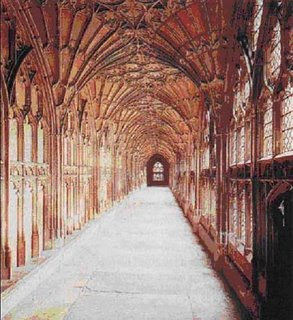
The Perpendicular style (in England). The fan vault.
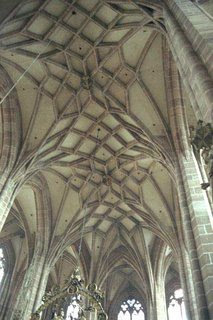
The flamboyant (in the rest of europe).

Here and there, two styles that we could say "baroque" or "way", so anachronistic since the baroque of the seventeenth and sixteenth of mannerism. Behind these two labels, the idea of decadence. As if the classic Gothic represented a climax, the "purity" of the Gothic.
Given our era, the functionalism of Le Corbusier and his successors, it is certain that the Gothic classic removes all the superfluous to show only the necessary construction, represents a key moment in the architecture itself itself, while the "perpendicular" and "flamboyant" are moments of decoration. However, there is no reason to make judgments of value, since we can conceive not history, in the manner of XIX: (Hegel, Marx) as a progression (with its judgments and flashbacks) to an ideal or some perfection.

Note also that if the sculpture tends to lib2rer the yoke of architecture in which it was made especially for Romanesque, it is nevertheless in harmony with it . Refinement of curves, the preciousness of columns will address the refinement and the preciousness of sculpture and painting of the fourteenth and fifteenth centuries.

II. SCULPTURE, PAINTING THE FORM
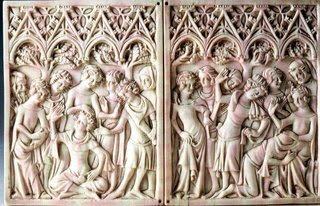
1. Refinement and preciousness


objects are small. Transportable. Made of ivory and precious materials (gold, silver, pearl, black horn), carved into the smallest detail and borrowing that grace which will feature, in fact, from the sixteenth century Mannerism. Statuettes, small diptychs and triptychs, etc.. serving the individual devotion.


2. Search for in the refusal depth of realism: the illumination.

Painting is first in the illuminations of manuscripts. It is there that takes the "search", one meets innovation.
The detachment from the architecture that allows the XIIth century prohibited: digging of the wall (disappeared in the Gothic architectre) perspective. Several options are being tested.

a. Atmospheric perspective

An "off" appears through a Thinning of the sky near the horizon line. Certainly there is nothing "realistic". The sun's rays are clearly marked as "rays". The landscape remains a separate remote that it can be instead to blend smoothly into the sky. But there are two plans: one near the other distance.
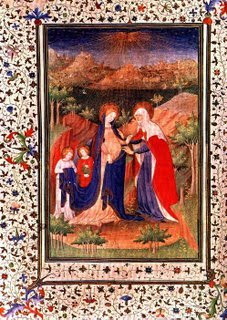

b. The diaphragm

Other means include the depth of a diaphragm lajout front of the stage. In the example below, two columns and crossbeam frame where the scene takes place. They confront us and creates a sort of backwards. The method of the diaphragm
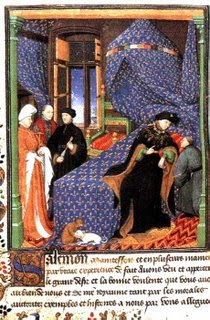
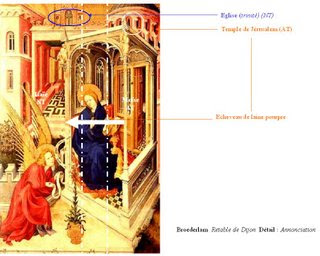
perfected two other processes which the former is more artificial, the second most symbolic. The first is to "remove" the wall that conceals the stage from inside a building called this approach: internal explicit). The second tile to the floor so that is clear that although the scene appears to be at the outside, it actually takes place inside (we call this approach: internal default).
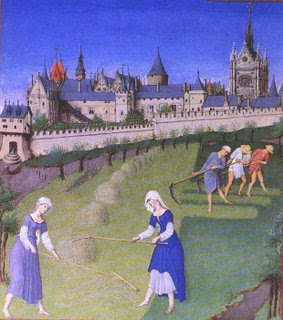
3. When naturalism appears, in a "Mannerist" non réaliste.Ex. The Limbourg brothers The Tres Riches Heures of the Duc de Berry .


Certainly, we see appear in this calendar the first snowy landscape, the first drop shadows, all of which left indifferent illuminators of previous eras certainly anxious to report laborious human activity (work months), but in a moralistic view (virtues related to work) and religious (the fruits of nature are gifts from God). If Calendar of Limbourg brothers also shows the work in the fields of vines, searching for acorns and wood for heating, it does so against a background of "valuable material" in each table is basically a castle Duke and many of the scenes are scenes of Court, and lay perfectly designed to enhance the nobility mettrre through the richness and especially its elegant ornaments.

3. The altarpiece.


But painting is not limited to illumination. The fifteenth century saw the development of the altarpiece and in the north (Belgium, Netherlands) at the expense of painting and sculpture. One of the most famous is the brothers van Eyck, and is the Cathedral of St. Bavo in Ghent: the Altarpiece of the Mystic Lamb . (Below, closed and open)
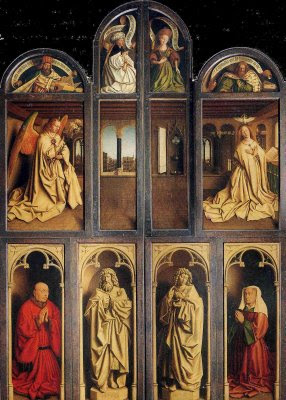
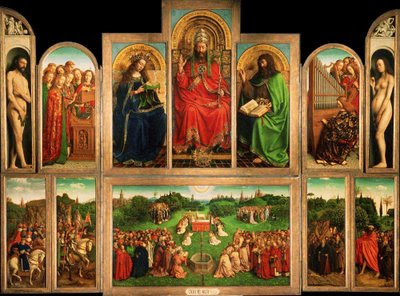


II. SCULPTURE, PAINTING THE CONTENT

1. Melancholy

The twelfth century was the age of faith . Belief in a God totally alien and terrifying. The Thirteenth is the age of piety. The belief in one God (severe and Father Judge) but understanding. The fourteenth and fifteenth centuries are centuries of devotion . Belief in a God human, all too human, died for men, a God of themes arising pitié.Plusieurs:
a. Death.

death, always present, becomes a haunting theme. It must be remembered that between 1347 and 1350 is half the European population (25 million people) which is decimated by the plague. In France, it is still rampant between 1353 and 1355. It is a threat to people's minds.
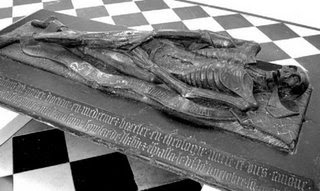
-Death is the subject of many illuminations.
-The " said the three dead and three living " which narrates the meeting of three young people with their own bodies, warning that death is always present, is in everyone's memory.
- The "Dance of Death " appeared
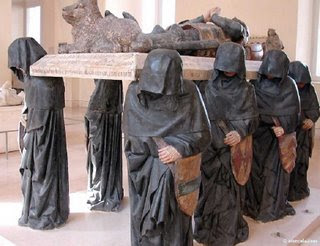
- In funerary art, lying in the transition succeeds. The deceased is no longer represented the stigmata of death. Tombs at two levels appear at the end of the fourteenth century. In the upper part, the spiritual part, immotelle the deceased. In the lower part of his hand injury, fatal.


- or crying (Below the Tomb of Philippe Pot , from the Cistercian Abbey).
b. Crucifixion.

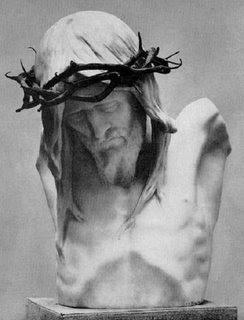
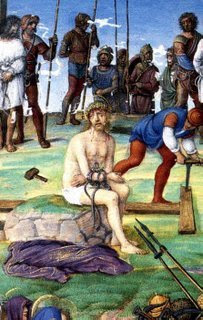
- A Byzantine and Romanesque, it is a triumphant Christ (of death) who is on the cross - A classic in the Gothic period, the Crucifixion has a value dogmatic teaching-Au XIV century, the idea of victory is gone, but the treatment is valuable and Mannerist .- In the fifteenth century, it is a suffering Christ, who is represented overwhelmed.
c. The figures of the suffering Christ.

often confused two figures: that of Mercy Christ and that of the Honne pain. The latter is an invention of the fifteenth century.

- pity Christ died at half-risen from the grave, or not supported by angels, he shows his wounds.

- The Man of Sorrows is alive again. It is the Christ in agony waiting to be crucified.


We are far here from the terrible God of the Apocalypse the tympanum of Moissac. Judge Supreme eardrums Gothic classic. Ecce Homo is the one who has suffered in his humanity all that it was possible to suffer. And died as every man dies. A close God, human, too human.
From age novel in the late fifteenth s one seems to watch the decline of a God, his "de-deification," which led to the end of medieval culture that will continue, however, some way in the North.
CHAPTER 6. RENAISSANCE IN THE NORTH, S XV (OR FLEMISH PRIMITIVES )

I. CODES
symbolism, evident in the medieval representation, lies in the Northern Renaissance. Any requests to be interpreted.

example: a Romanesque window will mean the Old Testament or ancient times or the time before time: the eternity of the Kingdom of God. A Gothic window will nominate the New Testament or the current time. A window is never a window, but a sign . Again, you must read. The difficulty is that this symbolism is hidden.

II. THE WORLD AS ALLEGORY.

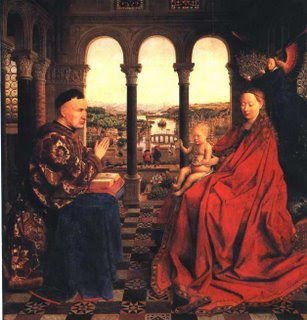
The difficulty in a work is whether a particular object or piece of scenery is a symbol intended by the painter or invented by the symbolism commentateur.Dans not completely consistent the first time ( The Master of Flemalle, eg Merode Altarpiece ) the problem arises effet.Il no longer arises then with masters such as Jan (or Hubert) Van Eyck.L interpretation of symbols The Madonna of Chancellor Rolin , for example (below) shows that the portrait of the Chancellor is not that of a donor, as for the first thinking, but the soul of it (death hence) brought into the Virgin in the City of God. Indeed, where is there? The view is sharp from foreground to infinity. It is not that of a human eye. Only God's eyes can capture all of the visible. We're in the City of God, not on earth and the table does not represent the Virgin in Majesty with portrait of the donor as is often the case.
The three arches are three and novels. Three: the trinity. Roman: ancient times, even the time before time, eternity. The Chancellor is dead and received by the Virgin in Paradise. Symbolism hidden in the guise of a scene immediately visible in other ways with Virgin Majecté donor).
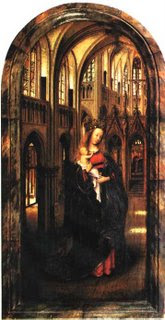
The figure of the Virgin in The Virgin in a Church (as of Jan van Eyck, below) is not the Virgin church or a church, but the Church in a shrine which is, itself, the Idea of the Church. That only a symbolic interpretation of the work shows.

The Virgin is indeed too large compared to the building. But all-in-fact in the proportions of classical church in a shrine. The church itself is not a church. The light comes from the north (given regular orientation of this building type). It is another thing. What? Given the disproportion of the Virgin, it is the shrine where the church is represented.

Similarly, it is not the Arnolfini on the eve of their wedding night is just as Van Eyck (Below), but the picture is a marriage certificate issued by the painter. This, only the interpretation of all symbols of the work can establish without doubt.
In the bottom of the mirror does not reflect seulemnt spouses, but (in the place we occupy as spectators of the table) the painter himself and another character: witness the marriage. The signature is not the traditional "Johanes van Eyck fecit" (Jan van Eyck did, this table) but "Johannes van Eyck fled hi c" (Jan van Eyck was here). All other signs and symbols confirms.


III. ARS NOVA

1. The Ars Nova is a new way of painting which emerged in the North in the fifteenth century

2. The color palette expands.

3. It uses oil paint, brighter, a greater color intensity and closer réel.4. It manages to give an illusion of reality to the table. But an illusion that does not disappoint as it presents itself as such and as to decipher.

IV. TOWARDS THE END OF SYMBOLISM

successors Van Eyck (Rogier van der Weyden, Petrus Christus, Dirk Bouts, Hugo van der Goes, Hans Memling, and others) will gradually renounce symbolisme.C is the Middle Ages ending. The world ceases to be the Scriptures of the Creator that the artist had to decipher. He begins to assert its autonomy as an "object" (an ob-ject) that science will have to take and who will need to be represented, new methods, new devices that the Italian Renaissance already, the fourteenth and fifteenth centuries to develop enthusiasm on his side.

Tablets That Kill You

(1) CHAPTER 6 THE RENAISSANCE IN ITALY: THE PERSPECTIVE

CHAPTER 6 THE RENAISSANCE IN ITALY: THE PERSPECTIVE
Jacques rouveyrol

I. CULTURAL DATA

A . Medieval culture is a symbolic thinking. Nature, the world is an expression of thought and the divine in physical form.
This material form cache (because thought is spiritual) and shows at once (because the material form has been shaped by the thought) the same thought. That is: a symbol .
In medieval culture, so there is God. The "nuts Saint Victor" is God in different appearances (see above).
Renaissance removes symbolic thinking and preparing scientific thought. God and the world (or Nature) divorce. We'll have to think about the world differently.
B . In the twelfth century, all knowledge is revealed. The means of knowledge is faith. Neither reason nor a fortiori senses have citizenship.
In XIII ° and XIV centuries, the foundation of knowledge is revealed and matters of faith. But the reason has been given to men by God, it must contribute to making knowledge more accessible to humans. Theology (St. Thomas Aquinas in particular) trying to reconcile the two ways of knowing: faith and raison.Les "science" have areas "reserved" and partly outside the control of the faith.
C . In the fifteenth century (especially in Italy), symbolic thought tends to disappear in favor of scientific thought that expands his empire (Copernicus, Polish, studies in Italy: the Earth is not the center of the world. Galileo soon: it turns on itself and around the sun. Giordano Bruno, finally: the universe is infinite) against religion.
Therefore to represent the world a new kind of "thought" and, for artists, a new system of representation. This will be: perspective.
II. THE SEARCH FOR THE DEPTH
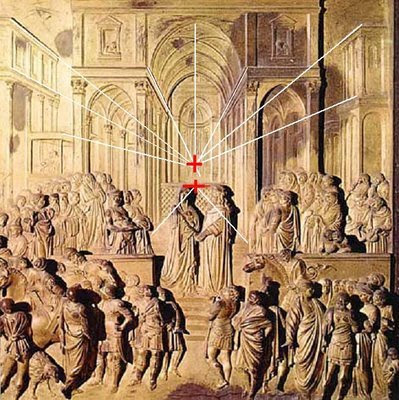
1. Centralized view bifocal: Ghiberti

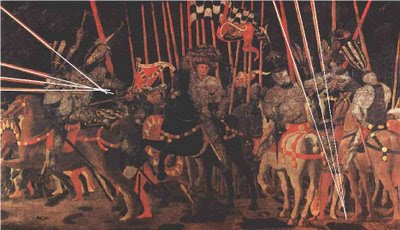
2. Lateralized bifocal perspective: Uccello

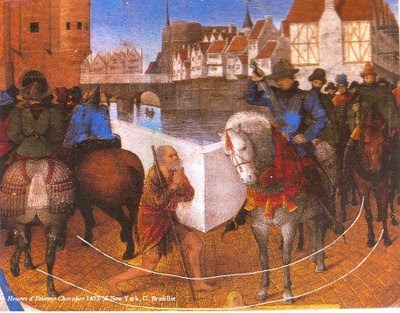
3. The prospect convex Fouquet

4. The prospect monofocal invented in Florence between 1420 and 1450
The political dimension: private space, public space. (The Strozzi to Cosimo de Medici). The public square as a place of historia .

When Cosimo de Medici returned from exile to Florence in 1434, he chased Palla Strozzi. It had been painted by Gentile da Fabriano's Adoration of the Magi , works belonging to prestigious international pure Gothic painting luxury but a complex narrative mess.
must in Como, to assert its difference with another art caractérisitques opposite: a sober and simple art. At least in public places (as for the private sector, such as his chapel at Palazzo Medici-Riccardi, he gives the same with Gothic International Benozzo Gozzoli). An art re-publican. This is precisely what makes the prospect. According to Albert, the prospect first constructs a public place (a place) which takes place a historia (which is history).
The rise of perspective is bound, although not exclusively but certainly, at this political upheaval in Florence.
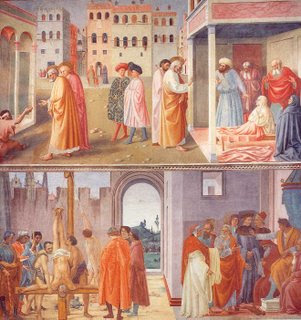
(Masolino & Lippi Church of Carmine)


III. SENSE OF PERSPECTIVE AND CONDITIONS

1. The Construzioni legitima

The perspective is also named Construzioni legitima , legitimate construction. This means that it passes for an objective, realistic the world.
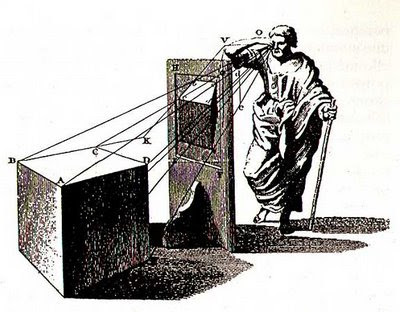
is the meaning of glass table Alberti. On the glass plate is reality itself which is inscribed to the eye at the top of the visual pyramid. Or sense, too, the TAVOLETTA Brunelleschi. The Baptistery of Florence is reflected "as is" in the mirror.

2. The world without God (Panofsky)

With the prospect is infinite which enters the world. He was previously reserved for God, transcendent. Here, entered the world, that he may without God.
Indeed, the vanishing lines that join to our vision on the horizon are actually parallel and, as such, do meet at infinity. Perspective, if it is not infinite is the suggestion.
3. A new world view centered on the topic (Francastel)

With the prospect is the subject of the vision that became the center of the world. The visible only becomes visible only from the point of view (visual top of the pyramid). The world becomes a stage on which man, as subject, that is to say as an actor (of vision) in the central square, Items not giving that compared to his perspective on them (which contradicts the belief in the objectivity of perception perspective).

4. A world view commensurate to man (Arasse)

With the perspective, the world becomes commensurable with the man. We return to the pretensions of the old Protagoras criticized by both Plato and Christian theology: "Man is the measure of all things." Thus the apparent size of objects decreases does, proportionally, depending on the distance to the human subject that perceives them.
5. Refutation belief in the objectivity of vision perspective.

- The first is a cyclopean vision. The perspective assumes an eye.
-
In addition, an objective view could be that of God (Van Eyck, The Madonna of Chancellor Rolin : clear vision, we have seen, from foreground to infinity discovering things like that 'they are; Bruegel, J them Children: panoptic vision which, while diving, a complete reference of all games).
-La Tavoletta then expresses clearly that the point of view about a particular place in the porch facing the Duomo Baptistery. Vision therefore strictly subjective.

-Moreover, contrary to what one might think the prospect is not there to make excat architecture since, in contrast, is the architecture that drifted from painting to the Renaissance.

-perspective is also not invented to make the depth. Other methods are used in parallel:
- segregation plans,
- The veduta.
Perspective is a method among others.
We'll see, moreover, it is not free of anomalies and, more importantly, these abnormalities far from clumsy demonstrations are intended by the artists (see Daniel ARRASS Annunciation Italian )

IV. "Anomalies" OUTLOOK

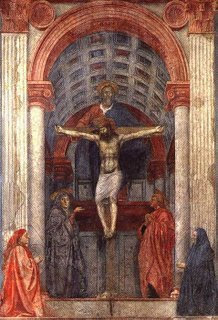
1. Trinity of Masaccio

The laws of perspective directs this composition. Only the cross and the body of Christ do not. What is the meaning of this anomaly? Is not that the being who is suspended from this cross is not of this world? It is not subject to the same laws?

2. The Italian annunciations

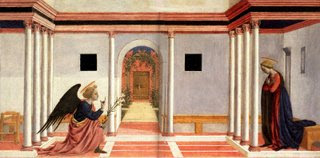
Daniel ARRASS note that many Italian annunciations presents similar anomalies. That of Domenico Veneziano, below, presents the curious feature of the show, its vanishing point, a doorknob disproportionate.

Domenico Veneziano


In this Annunciation by Fra Angelico, the vanishing point is ... forward: the middle column, preventing the eye to enjoy the depth normally generated by the flight lines

.................................... Fra Angelico


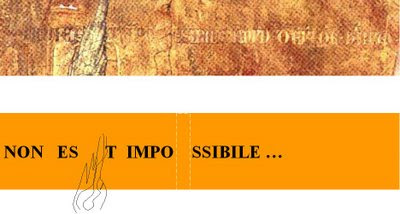
In this other Annunciation Lorenzetti, the perpespective does it seem that in the lower part tiled panel. Entire upper, gold, seems to ignore even the fact that an object can hide, even if only partially, another. Thus, before the written text: "non est impossibile " should spend a wing of the angel and the column. But the text stops at each "barrier" to restart later (see below). Without doubt this is one is, again, in a world that does not obey the laws of our own.

Ambrigio Lorenzetti
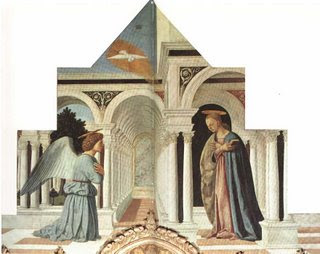
In the next Annunciation by Piero della Francesca, the angel and Mary are separated by a column. They can not see each other. The laws of perspective have allowed this paradoxical construction unequivocal. What does this mean?

.................... Piero della Francesca


Probably the latter. What is it represented in the Annunciation ? The very fact of the Incarnation . For, just when Mary agrees ("it is done according to his will"), it is permeated by the Spirit and the Savior is pregnant. But it was given to men to see Christ, God incarnate, he is given to anyone to see (or represent) the Incarnation. Anyway to give access to this event: the entry of the unrepresentable (God) in the world of things representable (the body), it was obvious to the impotence of perspectivecapable only to restore the things of our world.


The prospect is neither the means to objectively represent the world, nor the means to objectively represent our representation of the world. It can even be used symbolically to "appear" that is not our world. It is a device for expressing a new relationship in the world, a relationship in which man becomes the subject and hence the measure.

IV. SPACE AND TIME

Gradually, as the space has been unified, the time will get his unit. Successive scenes will not be displayed simultaneously on the same surface. In
Masaccio The Tribute the Carmine, there are still three times in a single space (Jesus to Peter intimating order to get money on the shore; Pierre running order; Pierre handing money). In The Banquet of Herod Philippo Lippo, Salome dance, center, receives the head of John the Baptist, left; she lays her head on the table, right.
is Leonardo da Vinci, who emphasize the incongruity there is to multiply the time dimension in the spatial unit, even Leonardo da Vinci, The Last Supper from repudiate the prospect

V. MISUNDERSTOOD THE "WINDOW" OF ALBERTI.

" My first act, when I want to paint an area, is to draw a rectangle the size that fits, as a window through which I can see the subject (historia) " De Pictura Alberti 1435 Book I, § 19 Contrary to what one might have thought, it was never intended for Alberti to open a window on the world.
It simply build the space of a table. This window is a frame. And a world table.

VI. FLORENTINE ARCHITECTURE

The picture is a world and a model for the world. Since this space Table derives the actual architectural space.
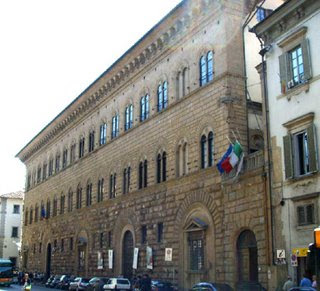
The medieval palace was a landing tower (eg Palazzo Vecchio in Florence). The Palace will be reborn antiquity. Thus marked by regularity, symmetry, proportion.
But above all by the visualization. Vision tools developed by Brunelleschi to visualize the project before its completion or even built. The architecture, with the prospect, was first designed and then implemented. It is the appearance of architectural projects.


Palazzo Medici-Riccardi (Michelozzo)
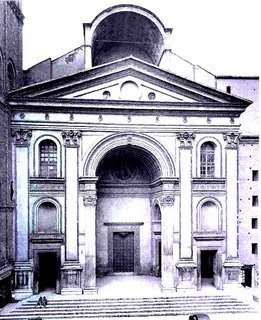
FlorenceEglise Saint-Andre (Alberti) Mantua

Honeymoon After Chicken Pox

RENAISSANCE (2) CHAPTER 7: THE CLASSICAL RENAISSANCE XIV-XV S

CHAPTER 7 THE RENAISSANCE IN ITALY THE CLASSICAL RENAISSANCE: XIV-XV Centuries .
Jacques rouveyrol

I. THE PRECURSORS: THE Trecento
Although the subject of the representation remains religions, we must bring the action on the ground and back to man. It is, at the end of XII ° s and early XIIIth the message itself St. Francis of Assisi and not just when he preaches to the birds.
1.Duccio (The School of Siena)

Duccio is the most important painter of the Sienese school. It is for him to bring the legendary scenes from the lives of the saints at the scenes of everyday life (street scene, indoor scene, the scene of road). The result is a desecration of space that makes possible a representation that the drains flatness. The space widens.
The Byzantine influence that characterized the Sienese school difference that of Florence conducted by Giotto.


2. Giotto (Florence School)


His goal: to conquer the third dimension. But instead of implementing it in space, it is in the objects it produces. Thus, for example, by placing a building at an angle, it creates depth.


The medieval space was a surface. A substantial area, that is to say, impenetrable, made a block, not to revise, to dig. The "revolution" by Giotto is just to dig the surface. Yet to deny. Thus, in any scene, the sky will be well "behind", but will remain an impenetrable surface and perfectly flat.


The picture is a "window" that widens the wall, certainly, and this is what is new, but that closes the space it has opened (and this is what remains of the "mentality" medieval) because, behind this "window" and just behind the world stops and goes no further.


The image is no longer a icon. Certainly it is not realistic. But it is more symbolic (over only). Space is no longer the sacred space of divine thought. It's profane space of the action humaine.C 'was provided for the abandonment of the flatness Romanesque (and Gothic yet) a sacred space partitioned into places, in favor of a secular space continuous and homogeneous .


II. PERSPECTIVE AND ANTIQUE

The prospect is particularly suited to the representation of classical architecture (ancient) characterized by their geometry: straight, cube, arc, ... So the first scene that will affect a classic form.

1.Under agreement with the figures in the sculpture: Donatello.


And before it, in Nanni di Banco and, simultaneously, or in Jacoppo della Quercia Ghiberti. The figures are inspired by Donatello Rome tick (David Gatamelatta ...)


2. Disagree with the figures in the painting until 1450-1460


In Piero della Francesca Francesco del Cossa and others, in a setting inspired by ancient times, the figures are dressed in modern and unsuited to the background on which they stand.
................................................ .......................

3.The agreement with the figures in the painting from 1450-1460.


Thus in Mantegna in his Life and Martyrdom of Saint Jacques. Although this is not always the case (eg in his Martyrdom of Saint Christopher).
agreement between scenery and ancient figures is taking place gradually promoted from operations a fund of non-Christian mythology. For example dear Piero di Cosimo:


So the decor, because it is tailored to the prospect, calling the figures to change and integrate.

4.The development of neo-Platonism (Marsilius Ficino) will renew the theme of painting and mythology reviewed by neo-Platonism will compete chrétienne.Exemple mythology: both Venus ( coelestis and vulgaris) by Botticelli. The reference is to Banquet of Plato. Socrates y two forms of love: the earthly love is love (desire) of beautiful bodies and heavenly love which is love of beauty itself. There are two Venus: Venus a terrestrial ( Venus vulgaris) born of the union of Jupiter and Juno and Venus Celestial ( Venus coelestis) born of the sea at the time of the fall of the genitalia of Uranus resulting from his castration. Surrounded by Zephyr and Flora (left) and Spring (right), the Celestial Venus by Botticelli out of the sea In the right panel, the earthly Venus topped Eros is between the Three Graces and Mercury a hand and the Spring Flora and Zephyr, on the other.
together, as below, the two charities. Left the celestial Venus, love disembodied (the so-called "platonic" and that does not mean "chaste love of beautiful bodies", as is often believed, but love of beauty in itself independently bodies in which it takes place or to which it gives form). The Centre (that is, on the left of the second table), Mercury is the reason that turns its back to the sensual temptress of the three Graces. Right, finally, the earthly Venus, carnal desire. So it's a route that here is drawn. A read from right to left: starting from the earthly love, we must, by means of reason, to rise to heavenly love (which is a little sense of scale Banquet). The two works by Botticelli is therefore meet, complement, must be read together.


5. Raphael: the synthesis of knowledge and worlds: the unification achieved.

is Raphael's responsibility to achieve greater unity of the different data. It represents the culmination of the Classical Renaissance. His School of Athens (1509) in Segnatura the Vatican presents a synthesis of ancient thought, but this, again, synthetically. Not only are all philosophers and scholars of antiquity met there, but not simply juxtaposed in this space perfectly strucure by perspective. For example, opposition Plato (taking an intelligible heaven where the "Forms" that give the pure material of this world of forms understandable) / Aristotle (for whom the "Forms" are already there, in power in the matter), this opposition is noted by setting side by side the two characters and the fact that the hand of Plato means heaven while Aristotle is facing the Earth. Thus, for example again, the message of the ancient Greek citizenship was clearly expressed by the route of the young man who climbs the stairs. He turns away from Diogenes, a-social, sitting on the steps and gestures on a former which refers to Aristotle, the social theorist (author of The Policy or the Nicomachean Ethics, the which defines the man "a political animal", that is to say, "a social animal), it goes to the philosopher.
And in Dispute of the Blessed Sacrament is the synthesis of Christian thought that Raphael (in the same 15110-1511 Segnatura ) performs. A total synthesis of all forms of thought.


The Classical Renaissance succeeded thus complete unification: space, time, figure and scenery, ancient history, and contemporary Christian. She created a world.