Saturday, March 7, 2009

Company Anniversary Speech Sample

GOTHIC ART (3) Chapter 4 (continued) THE SCULPTURE

ART GOTHIC
CHAPTER 4: THE GOTHIC SCULPTURE (continued)
Jacques rouveyrol

II. ICONOGRAPHY: THE FORM.

1. New themes :
From the Apocalypse eardrums novels we pass on the eardrums Gothic Christ in glory at the Last Judgement and the Glory of the Virgin. God ceases to be this terrible and irrelevant to humans. He became the Father. One who shares the good and evil, reward or punish. Is that her son has a mother, like men. God has "humanized". It nevertheless remains a severe judge. but that his Mother or the Saints can be influenced by their prayers.
2. Gothic grammar.

a. Signs, not symbols .
images (sculptures, paintings) together produce a script made of signs not symbols as repeated too souvent.Un sign is a difference. A sign that only makes sense to distinguish the signs which it attaches itself. The report of the signifier (eg the cruciform nimbus halo that the face of Christ) to the signified (Christ) is arbitrary (we could have him add a non-cruciferous nimbus, as does the other saints). While the report in the symbol of the signifier (the cross, for example) to the signified (the Christians) is "justified" (in the sense that Christians can not be represented by anything: a scale or a sword, which valent them to justice). Thus, Jesus inherited the cruciform nimbus has no other meaning than this: it is not confused with those who inherit the simple nimbus. But the reverse would have been possible.La mandorla or glory surrounding a body designated by it as being that of God or the Virgin. Barefoot, God, Jesus, angels, the apostles. To distinguish them from the Virgin, saints and other ordinary people (not provided with a halo and thus distinguished from the Virgin and other saints who have in common with them to have their feet shod).


b. Types.
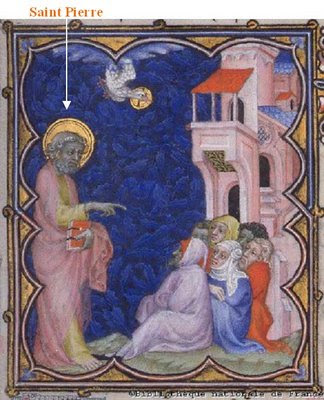
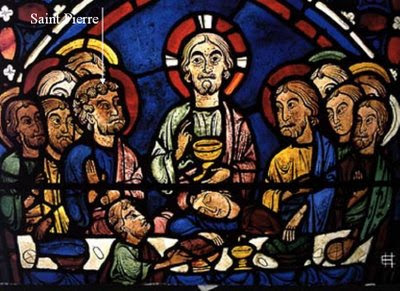
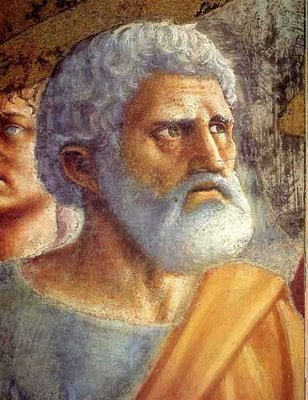
Types are gradually up until we find in works of the seventeenth, XVII and XIX centuries even. Thus, there is a type Saint-Pierre, recognizable features of the face, independent of the keys are another sign of recognition (that is to say, of distinction). St. Paul type, independent of the sword that distinguishes turn. One type Saint Jean-Baptiste (less independent, this time, the skin of sheep that dresses).

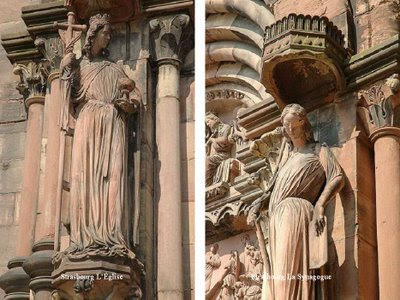
Other figures are constants of the Gothic script. Thus the Church (Virgin crowned, bearing in his hand the Grail who collected the blood of Christ) opposite the Synagogue (woman coronnée a pointed hat, blindfolded (there is the symbol). The first is the message of Christ so clearly and directly granted by God Himself in the person of his son. The second carries the message distorted, veiled prophets and failed to recognize the divinity of Jesus.
c. The hierarchy of places: up / down, right / left.
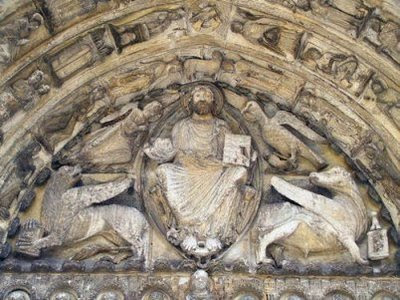
Depending on whether the figure is placed in one place or another, its value is not the same. In Tetramorph example, St. Matthew is at the top right (of Christ) and St. John on the left while St. Mark and St. Luke are respectively the bottom left and right (of Christ).

d. The Order of the retail :
The bases of statues. They say something about the statue that they support. Basil and IPAC (death and sin) are under the feet of Christ in triumph. The Saints have beneath them the kings who were persecuted and, in the end, they triumphed them too.
locations in the church have their meaning. In North (night and wrinkling) episodes from the Old Testament. South (day, heat) of Nouveau.Les those numbers, in turn, sigifient.
What are the twelve apostles is not indifferent. "4" is the number of matter (four items) and "3", that of the spirit (Holy Trinity). Thus ("4x3 = 12") the apostles are those who import the spirit in matter, God in the world.

5. Symbols.
cinqVierges The wise correspond to the five contemplations while the five foolish virgins describe the five senses and lust). The Resurrection means lion.
Attributes: Lamb / John the Baptist, Moses / serpent of brass or tables of the law, Abraham / young child (Isaac), Isaiah / stem of Jesse.
6. Painting.
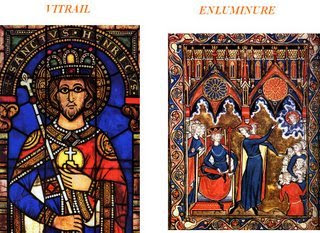
Gothic painting to stained glass is to be found. The illumination is only imitating the light and texture of the window.

III. ICONOGRAPHY: THE CONTENT.

The cathedral is not only an arch or foreshadowing of the heavenly Jerusalem (City of God), it is as a book. No, once again, a bible of the illiterate, because you have just read (we have just seen) to understand the iconography, but rather an encyclopedia that summarizes and explains the totality of knowledge (of the time ). (See Emile Male). The source, the Speculum majus ( The Great Mirror of the World ) of Vincent of Beauvais, which splits into four "mirrors".

1. The Mirror of Nature .
Nature is nothing but the incarnation of the Mind of God. He has designed, he created under his plans, it expresses exactly his thinking. Rest you need to know to read it. All the work of "science" is to decipher what "text". So, take a walnut (nothing is more common), the nuts of St. Victor. First there is the envelope. It has two meanings: it is either the humanity of Christ or the World. Then there is the shell which will have two more meaning in connection with those of the envelope: it is the wood of the cross or sin. Finally there is the fruit that is the hidden divinity of Christ or the Mind of God. So all in all things and God everywhere.


There are still animals. All, of course, are not symbolic. The most important designate the four Evangelists. They are the Tetramorph. This is the Eagle (St. John but also Ascension of Jesus, and among the virtues, contemplation), the angel or man (Matt. but also the incarnation of Jesus and, as a virtue, wisdom ), Lion (St. Mark's but also the Resurrection of Jesus, and courage as a virtue) and Ox (St Luke, but also the Crucifixion of Jesus, and temperance as a virtue). The snake (or dragon) is the devil. The elephant symbolizes the Fall. The asp is sin and basil death, he was vu.Encore once all the animals are not symbolic. The oxen of Laon are a tribute to the work done by these animals during the construction of the cathedral. Besides, they express creative power of God (see, for example at the north portal of Chartres Creation of Animals).

2.The mirror Science .

Cathedral is the mirror of nature. She is also a mirror of science. On its walls all that science knowledge has exposed.

a. Practical Science :

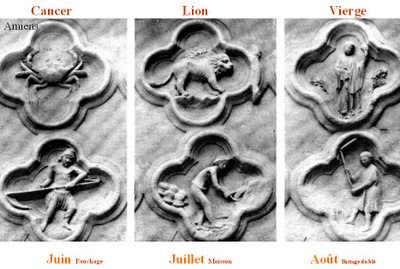
Letravail. These are the "calendars" describing the s occupation of each month linked with the zodiac sequence.
b. Speculative science :

The medieval science is not like ours, an instrument of domination of nature (science, "Make ourselves masters and possessors of nature", Descartes was programming since the seventeenth century), it is the interpreter. And she taught in a specific order. Hence the organization of studies: the trivium (grammar, dialectic, rhetoric) and quadrivium (geometry, artithmétique, astronomy, music), finally philosophy (or theology). These are the disciplines who will be personified (often by reference to an authentic scholar (Aristotle, Pythagoras, Boethius, etc.)..

c. The exclusion of laziness :

If science is manifested in the work, it takes the number of figures who represent the antithetical figure of laziness which is under the form of the Wheel of Fortune. Randomly assign the task of providing for our sustenance, here is laziness the mother of all vices.

3. The Mirror of Morality .

The third dimension of knowledge, is the moral, behavioral science.

a. The novel model :

There is a moral novel model: The Psychomachia Prudence: the battle of virtues and vices that adorns many capitals. It is an internal struggle which will inspire sculptors novels. The Gothic will look elsewhere and not to the same models as they are illuminators and sculptors.

b. Gothic models for illumination:

The Tree of Virtues and Vices (below) of Hugh of St. Victor and the Ladder of Virtues of Honorius of Autun.

c. Sculptors :

They detain any of these models and contrast pairs virtues and vices.
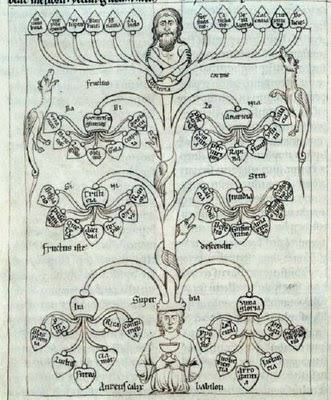

We will hold with the theologians of the time, three catégiories virtues:

->. the theological virtues: Faith (idolatry), Hope (Vice: despair), Charity (vice: greed). These are virtues without which there is no hope of Hi.
->. the cardinal virtues: Chastity (vice: intemperance), Prudence (or Wisdom defect: insanity), Strength (or courage vice: cowardice), Justice (or obedience; vice: Rebellion).
->. other virtues, for example, humility (Vice: pride), patience (vice: anger), sweetness (vice: hardness), harmony (or peace; vice: discord), etc..

4. The Mirror of History

Finally, the cathedral will be the mirror History. Not to profane history is hardly provided with meaning, but the only history that is worth: Sacred History as recorded by the Old and New Testament . This History, will be to understand, that is to say, since the Old Testament is the proclamation of the New, to find correspondences between the two. The lives of saints on one side and the Jewish people, on the other, reason from one end to another of history. We must understand and explain these reasons.
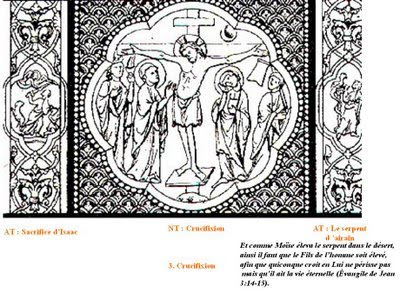
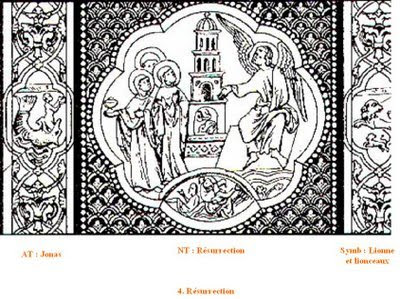
Thus the Sacrifice of Isaac prefigures Does Christ's. The water from the rock by Moses the blood that escapes from the wound made in the side of Christ by Longinus. Jonas from the mouth of the whale, the resurrection of Christ. And so on. The windows of the cathedral are subtle commentaries on the Bible.

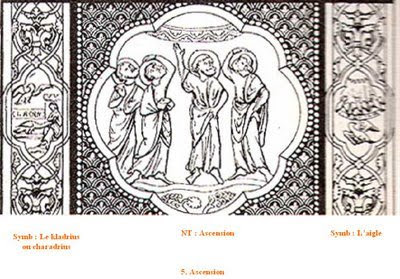
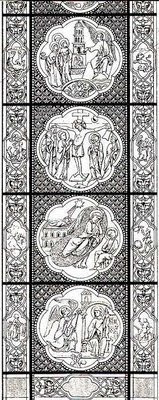
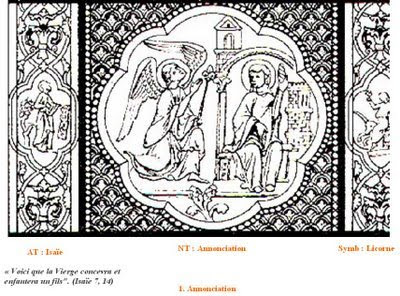
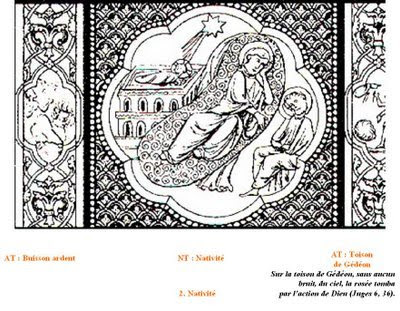
Let this piece of stained glass from Lyon. It establishes connections between Old Testament, New Testament and symbols. This gives, from bottom to top:

1. Isaiah the prophet who announced the birth of Jesus by a Madonna, the Annunciation, the angel who announces the birth of Jesus to the Virgin and the Unicorn, is a clean animal that can be approached only by a virgin.
2. The burning bush burning without being consumed, the Virgin birth without having "consumed" the fleece of Gideon is covered with dew no natural reason.
3. Abraham prepared to sacrifice Isaac in obedience to God, Jesus sacrificed himself on the cross for the salvation of men, the serpent of brass is high in the desert by Moses to save the Jews sent fiery serpents as punishment
4. spit Jonah by the whale returns to the world Jesus resurrected on the third day, the lions that seem dead in the first three days seem to come alive again the third under the inspiration of their father.
5. The kladrius is a bird that can tell whether a patient will live or die; Ascension of Christ who will live after death so the eagle is the bird that rises above and to learn to fly his small, the load on its wings.
Each text, moreover, carries three meanings: the literal or historical meaning (we reported a fact: Abraham existed) and a moral sense or tropological ( is the immediate meaning of this fact: the Faith. Abraham, despite the hesitations of God who gives and takes away a son obeys, no doubt for a second that it is God which he directs. He does not know that God tests his faith, of course, otherwise it would not be an ordeal, but he thinks). A mystical or allegorical meaning (the Crucifixion of Christ prefigured by the sacrifice of Isaac).

But the life of Christ (New Testament is to interpret). And legends attached to them without having figured. Thus one of two midwives and Salome Zelem example. One is surprised that Mary is still a virgin after giving birth and one question. When verifying the hand, it dries out. Only by asking forgiveness and Child Jesus and by an act of faith she finds the use of sipping his main sources of inspiration, in addition to the New Testament will The Golden Legend of Jacques de Voragine.

5. The Evolution representations.
can see the contents of Gothic sculpture and its sources. Consider also, ultimately, shape. Not the general characteristics discussed above, but its special features. Especially the evolution of certain figures, for example, the Virgin

a. Roman:
Virgin in Majesty. Frontal, hieratic sitting on his throne with the Child on her lap, she is the throne of God. Nothing that is feminine or maternal.


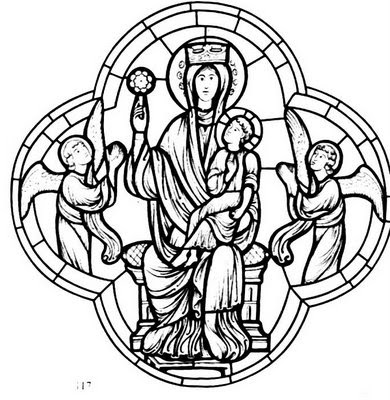
b. Early Gothic :

Top humanization of the Virgin. In the thirteenth century, the Virgin "humanized". The child slips on one knee and turned his face towards her mother, or playing with her.
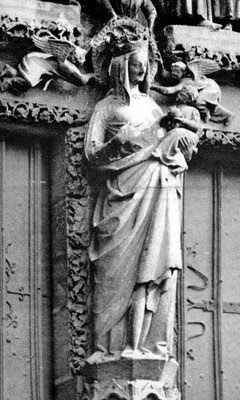
d. Classic gothic :

The Virgin Mother. Here it is standing, holding the Child on her arm and smiling at him. The Virgin became a mother.

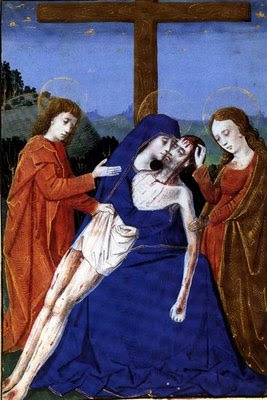
e. Latest Gothic

Woman. In the fifteenth century, is the Lady of Pain, the mother who just lost her child. Souffre.Ainsi the woman who, as God "humanized", as noted above, the Virgin is experiencing a similar humanization.
f. Life of the Virgin

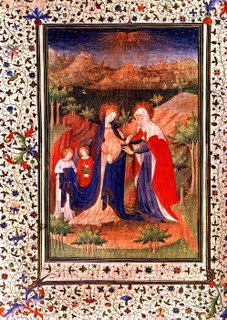
Life of the Virgin becomes a key theme of writing in portals and on the facades of cathedrals. The scenes are represented most naturally the Annunciation, the Visitation, death and Assumption.
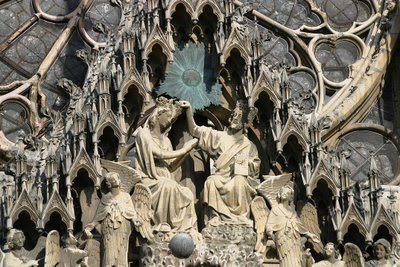
An apparently very common theme is stated on the tympanum of the Coronation of the Virgin. This view of things being otherwise objectionable. Indeed the fact of placing a wreath on the head d'une vierge équivaut de la part d'un homme à une demande en mariage. Il est évident que ce n'est pas sa mère que le Christ demande en mariage. Par ailleurs, on se souvient qu'une femme portant couronne caractérisait l'Eglise par opposition à la Synagoge. Ainsi, le Couronnement de la Vierge, ne serait en fait que le Mariage mystique de Dieu avec l'Eglise.
Cette représentation évolue au cours du temps. Dans la formule la plus ancienne, la couronne est déjà sur la tête de "la Vierge". Puis, il reviendra à un ange de déposer la couronne. Dans la formule finale, vers 1250 (la plus explicitement matrimoniale) c'est le Christ qui dépose la couronne sur la tête de l'Eglise.

The cathedral is not an arch in which mankind can seek refuge, not only the foreshadowing of the heavenly Jerusalem, it is a book. An encyclopedia or reflects all the knowledge of the Middle Ages. When, in Notre-Dame de Paris, Victor Hugo, entitled the chapter in which he mentions the invention of printing and the end of medieval architecture: This will kill it, it esprime perfectly the reality of Gothic sculpture.

Pokemon Chaos Black Character

GOTHIC ART GOTHIC (4) CHAPTER 5 THE INTERNATIONAL GOTHIC RENAISSANCE

ART GOTHIC
CHAPTER 5 THE INTERNATIONAL GOTHIC
Jacques rouveyrol

I. ARCHITECTURE

two styles share the second half of the fourteenth and fifteenth centuries
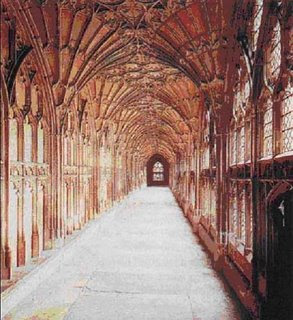
The Perpendicular style (in England). The fan vault.
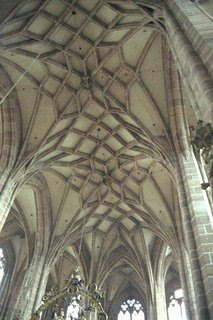
The flamboyant (in the rest of europe).

Here and there, two styles that we could say "baroque" or "way", so anachronistic since the baroque of the seventeenth and sixteenth of mannerism. Behind these two labels, the idea of decadence. As if the classic Gothic represented a climax, the "purity" of the Gothic.
Given our era, the functionalism of Le Corbusier and his successors, it is certain that the Gothic classic removes all the superfluous to show only the necessary construction, represents a key moment in the architecture itself itself, while the "perpendicular" and "flamboyant" are moments of decoration. However, there is no reason to make judgments of value, since we can conceive not history, in the manner of XIX: (Hegel, Marx) as a progression (with its judgments and flashbacks) to an ideal or some perfection.

Note also that if the sculpture tends to lib2rer the yoke of architecture in which it was made especially for Romanesque, it is nevertheless in harmony with it . Refinement of curves, the preciousness of columns will address the refinement and the preciousness of sculpture and painting of the fourteenth and fifteenth centuries.

II. SCULPTURE, PAINTING THE FORM
1. Refinement and preciousness


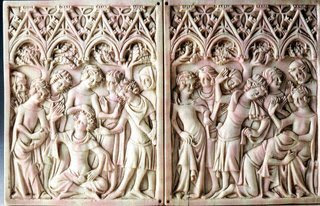
objects are small. Transportable. Made of ivory and precious materials (gold, silver, pearl, black horn), carved into the smallest detail and borrowing that grace which will feature, in fact, from the sixteenth century Mannerism. Statuettes, small diptychs and triptychs, etc.. serving the individual devotion.


2. Search for in the refusal depth of realism: the illumination.

Painting is first in the illuminations of manuscripts. It is there that takes the "search", one meets innovation.
The detachment from the architecture that allows the XIIth century prohibited: digging of the wall (disappeared in the Gothic architectre) perspective. Several options are being tested.

a. Atmospheric perspective

An "off" appears through a Thinning of the sky near the horizon line. Certainly there is nothing "realistic". The sun's rays are clearly marked as "rays". The landscape remains a separate remote that it can be instead to blend smoothly into the sky. But there are two plans: one near the other distance.


b. The diaphragm

Other means include the depth of a diaphragm lajout front of the stage. In the example below, two columns and crossbeam frame where the scene takes place. They confront us and creates a sort of backwards. The method of the diaphragm
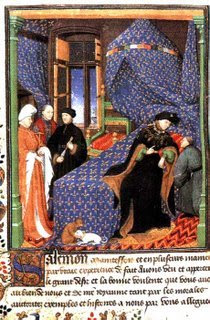
perfected two other processes which the former is more artificial, the second most symbolic. The first is to "remove" the wall that conceals the stage from inside a building called this approach: internal explicit). The second tile to the floor so that is clear that although the scene appears to be at the outside, it actually takes place inside (we call this approach: internal default).


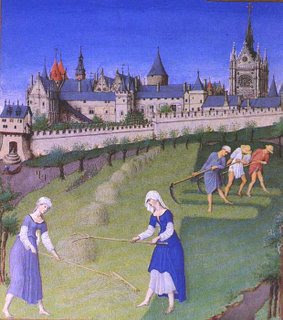
3. When naturalism appears, in a "Mannerist" non réaliste.Ex. The Limbourg brothers The Tres Riches Heures of the Duc de Berry .


Certainly, we see appear in this calendar the first snowy landscape, the first drop shadows, all of which left indifferent illuminators of previous eras certainly anxious to report laborious human activity (work months), but in a moralistic view (virtues related to work) and religious (the fruits of nature are gifts from God). If Calendar of Limbourg brothers also shows the work in the fields of vines, searching for acorns and wood for heating, it does so against a background of "valuable material" in each table is basically a castle Duke and many of the scenes are scenes of Court, and lay perfectly designed to enhance the nobility mettrre through the richness and especially its elegant ornaments.

3. The altarpiece.


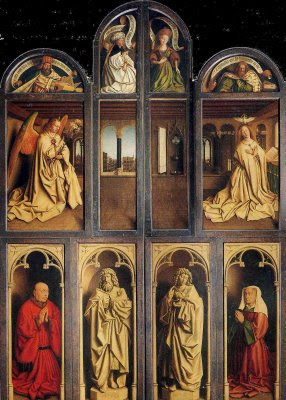
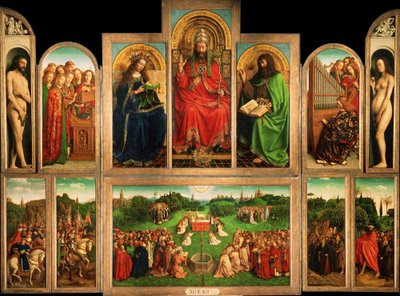
But painting is not limited to illumination. The fifteenth century saw the development of the altarpiece and in the north (Belgium, Netherlands) at the expense of painting and sculpture. One of the most famous is the brothers van Eyck, and is the Cathedral of St. Bavo in Ghent: the Altarpiece of the Mystic Lamb . (Below, closed and open)


II. SCULPTURE, PAINTING THE CONTENT

1. Melancholy

The twelfth century was the age of faith . Belief in a God totally alien and terrifying. The Thirteenth is the age of piety. The belief in one God (severe and Father Judge) but understanding. The fourteenth and fifteenth centuries are centuries of devotion . Belief in a God human, all too human, died for men, a God of themes arising pitié.Plusieurs:
a. Death.

death, always present, becomes a haunting theme. It must be remembered that between 1347 and 1350 is half the European population (25 million people) which is decimated by the plague. In France, it is still rampant between 1353 and 1355. It is a threat to people's minds.
-Death is the subject of many illuminations.
-The " said the three dead and three living " which narrates the meeting of three young people with their own bodies, warning that death is always present, is in everyone's memory.
- The "Dance of Death " appeared
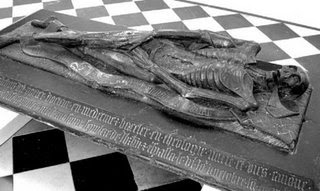
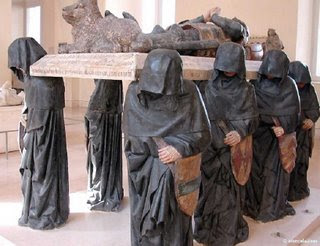
- In funerary art, lying in the transition succeeds. The deceased is no longer represented the stigmata of death. Tombs at two levels appear at the end of the fourteenth century. In the upper part, the spiritual part, immotelle the deceased. In the lower part of his hand injury, fatal.


- or crying (Below the Tomb of Philippe Pot , from the Cistercian Abbey).

b. Crucifixion.

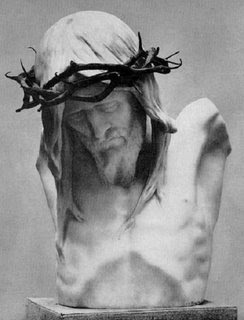
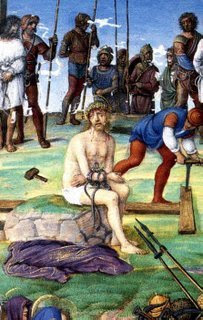
- A Byzantine and Romanesque, it is a triumphant Christ (of death) who is on the cross - A classic in the Gothic period, the Crucifixion has a value dogmatic teaching-Au XIV century, the idea of victory is gone, but the treatment is valuable and Mannerist .- In the fifteenth century, it is a suffering Christ, who is represented overwhelmed.

c. The figures of the suffering Christ.

often confused two figures: that of Mercy Christ and that of the Honne pain. The latter is an invention of the fifteenth century.

- pity Christ died at half-risen from the grave, or not supported by angels, he shows his wounds.

- The Man of Sorrows is alive again. It is the Christ in agony waiting to be crucified.


We are far here from the terrible God of the Apocalypse the tympanum of Moissac. Judge Supreme eardrums Gothic classic. Ecce Homo is the one who has suffered in his humanity all that it was possible to suffer. And died as every man dies. A close God, human, too human.
From age novel in the late fifteenth s one seems to watch the decline of a God, his "de-deification," which led to the end of medieval culture that will continue, however, some way in the North.

CHAPTER 6. RENAISSANCE IN THE NORTH, S XV (OR FLEMISH PRIMITIVES )

I. CODES
symbolism, evident in the medieval representation, lies in the Northern Renaissance. Any requests to be interpreted.

example: a Romanesque window will mean the Old Testament or ancient times or the time before time: the eternity of the Kingdom of God. A Gothic window will nominate the New Testament or the current time. A window is never a window, but a sign . Again, you must read. The difficulty is that this symbolism is hidden.

II. THE WORLD AS ALLEGORY.

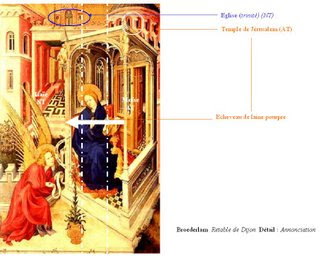
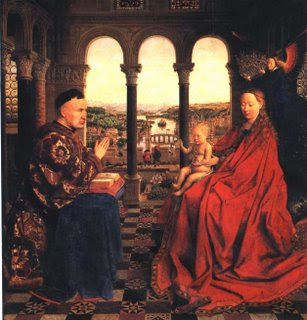
The difficulty in a work is whether a particular object or piece of scenery is a symbol intended by the painter or invented by the symbolism commentateur.Dans not completely consistent the first time ( The Master of Flemalle, eg Merode Altarpiece ) the problem arises effet.Il no longer arises then with masters such as Jan (or Hubert) Van Eyck.L interpretation of symbols The Madonna of Chancellor Rolin , for example (below) shows that the portrait of the Chancellor is not that of a donor, as for the first thinking, but the soul of it (death hence) brought into the Virgin in the City of God. Indeed, where is there? The view is sharp from foreground to infinity. It is not that of a human eye. Only God's eyes can capture all of the visible. We're in the City of God, not on earth and the table does not represent the Virgin in Majesty with portrait of the donor as is often the case.
The three arches are three and novels. Three: the trinity. Roman: ancient times, even the time before time, eternity. The Chancellor is dead and received by the Virgin in Paradise. Symbolism hidden in the guise of a scene immediately visible in other ways with Virgin Majecté donor).

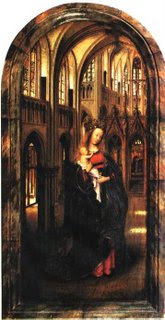
The figure of the Virgin in The Virgin in a Church (as of Jan van Eyck, below) is not the Virgin church or a church, but the Church in a shrine which is, itself, the Idea of the Church. That only a symbolic interpretation of the work shows.

The Virgin is indeed too large compared to the building. But all-in-fact in the proportions of classical church in a shrine. The church itself is not a church. The light comes from the north (given regular orientation of this building type). It is another thing. What? Given the disproportion of the Virgin, it is the shrine where the church is represented.

Similarly, it is not the Arnolfini on the eve of their wedding night is just as Van Eyck (Below), but the picture is a marriage certificate issued by the painter. This, only the interpretation of all symbols of the work can establish without doubt.
In the bottom of the mirror does not reflect seulemnt spouses, but (in the place we occupy as spectators of the table) the painter himself and another character: witness the marriage. The signature is not the traditional "Johanes van Eyck fecit" (Jan van Eyck did, this table) but "Johannes van Eyck fled hi c" (Jan van Eyck was here). All other signs and symbols confirms.


III. ARS NOVA

1. The Ars Nova is a new way of painting which emerged in the North in the fifteenth century

2. The color palette expands.

3. It uses oil paint, brighter, a greater color intensity and closer réel.4. It manages to give an illusion of reality to the table. But an illusion that does not disappoint as it presents itself as such and as to decipher.

IV. TOWARDS THE END OF SYMBOLISM

successors Van Eyck (Rogier van der Weyden, Petrus Christus, Dirk Bouts, Hugo van der Goes, Hans Memling, and others) will gradually renounce symbolisme.C is the Middle Ages ending. The world ceases to be the Scriptures of the Creator that the artist had to decipher. He begins to assert its autonomy as an "object" (an ob-ject) that science will have to take and who will need to be represented, new methods, new devices that the Italian Renaissance already, the fourteenth and fifteenth centuries to develop enthusiasm on his side.

Tablets That Kill You

(1) CHAPTER 6 THE RENAISSANCE IN ITALY: THE PERSPECTIVE

CHAPTER 6 THE RENAISSANCE IN ITALY: THE PERSPECTIVE
Jacques rouveyrol

I. CULTURAL DATA

A . Medieval culture is a symbolic thinking. Nature, the world is an expression of thought and the divine in physical form.
This material form cache (because thought is spiritual) and shows at once (because the material form has been shaped by the thought) the same thought. That is: a symbol .
In medieval culture, so there is God. The "nuts Saint Victor" is God in different appearances (see above).
Renaissance removes symbolic thinking and preparing scientific thought. God and the world (or Nature) divorce. We'll have to think about the world differently.
B . In the twelfth century, all knowledge is revealed. The means of knowledge is faith. Neither reason nor a fortiori senses have citizenship.
In XIII ° and XIV centuries, the foundation of knowledge is revealed and matters of faith. But the reason has been given to men by God, it must contribute to making knowledge more accessible to humans. Theology (St. Thomas Aquinas in particular) trying to reconcile the two ways of knowing: faith and raison.Les "science" have areas "reserved" and partly outside the control of the faith.
C . In the fifteenth century (especially in Italy), symbolic thought tends to disappear in favor of scientific thought that expands his empire (Copernicus, Polish, studies in Italy: the Earth is not the center of the world. Galileo soon: it turns on itself and around the sun. Giordano Bruno, finally: the universe is infinite) against religion.
Therefore to represent the world a new kind of "thought" and, for artists, a new system of representation. This will be: perspective.
II. THE SEARCH FOR THE DEPTH
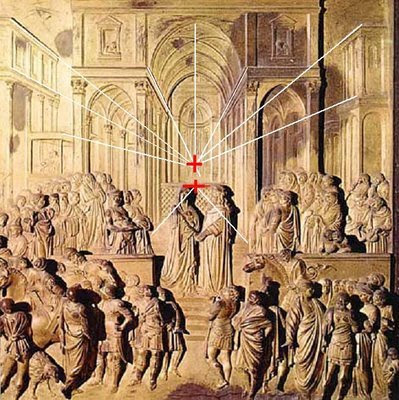
1. Centralized view bifocal: Ghiberti

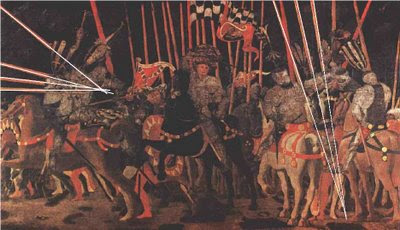
2. Lateralized bifocal perspective: Uccello

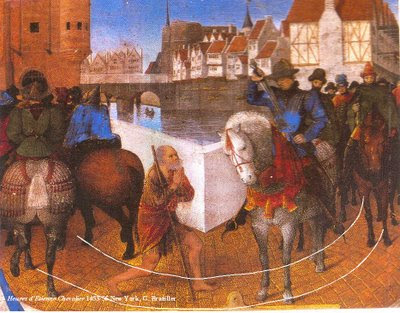
3. The prospect convex Fouquet

4. The prospect monofocal invented in Florence between 1420 and 1450
The political dimension: private space, public space. (The Strozzi to Cosimo de Medici). The public square as a place of historia .

When Cosimo de Medici returned from exile to Florence in 1434, he chased Palla Strozzi. It had been painted by Gentile da Fabriano's Adoration of the Magi , works belonging to prestigious international pure Gothic painting luxury but a complex narrative mess.
must in Como, to assert its difference with another art caractérisitques opposite: a sober and simple art. At least in public places (as for the private sector, such as his chapel at Palazzo Medici-Riccardi, he gives the same with Gothic International Benozzo Gozzoli). An art re-publican. This is precisely what makes the prospect. According to Albert, the prospect first constructs a public place (a place) which takes place a historia (which is history).
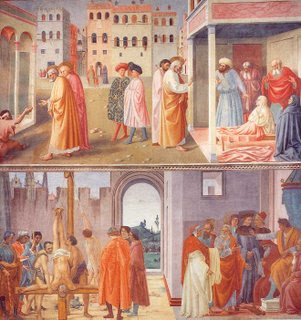
The rise of perspective is bound, although not exclusively but certainly, at this political upheaval in Florence.
(Masolino & Lippi Church of Carmine)


III. SENSE OF PERSPECTIVE AND CONDITIONS

1. The Construzioni legitima

The perspective is also named Construzioni legitima , legitimate construction. This means that it passes for an objective, realistic the world.
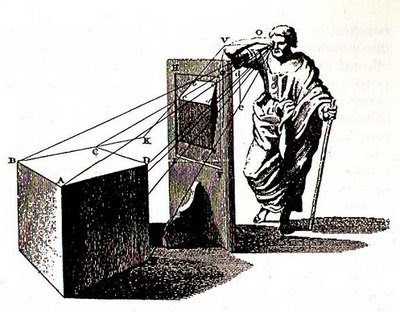
is the meaning of glass table Alberti. On the glass plate is reality itself which is inscribed to the eye at the top of the visual pyramid. Or sense, too, the TAVOLETTA Brunelleschi. The Baptistery of Florence is reflected "as is" in the mirror.

2. The world without God (Panofsky)

With the prospect is infinite which enters the world. He was previously reserved for God, transcendent. Here, entered the world, that he may without God.
Indeed, the vanishing lines that join to our vision on the horizon are actually parallel and, as such, do meet at infinity. Perspective, if it is not infinite is the suggestion.
3. A new world view centered on the topic (Francastel)

With the prospect is the subject of the vision that became the center of the world. The visible only becomes visible only from the point of view (visual top of the pyramid). The world becomes a stage on which man, as subject, that is to say as an actor (of vision) in the central square, Items not giving that compared to his perspective on them (which contradicts the belief in the objectivity of perception perspective).

4. A world view commensurate to man (Arasse)

With the perspective, the world becomes commensurable with the man. We return to the pretensions of the old Protagoras criticized by both Plato and Christian theology: "Man is the measure of all things." Thus the apparent size of objects decreases does, proportionally, depending on the distance to the human subject that perceives them.
5. Refutation belief in the objectivity of vision perspective.

- The first is a cyclopean vision. The perspective assumes an eye.
-
In addition, an objective view could be that of God (Van Eyck, The Madonna of Chancellor Rolin : clear vision, we have seen, from foreground to infinity discovering things like that 'they are; Bruegel, J them Children: panoptic vision which, while diving, a complete reference of all games).
-La Tavoletta then expresses clearly that the point of view about a particular place in the porch facing the Duomo Baptistery. Vision therefore strictly subjective.

-Moreover, contrary to what one might think the prospect is not there to make excat architecture since, in contrast, is the architecture that drifted from painting to the Renaissance.

-perspective is also not invented to make the depth. Other methods are used in parallel:
- segregation plans,
- The veduta.
Perspective is a method among others.
We'll see, moreover, it is not free of anomalies and, more importantly, these abnormalities far from clumsy demonstrations are intended by the artists (see Daniel ARRASS Annunciation Italian )

IV. "Anomalies" OUTLOOK

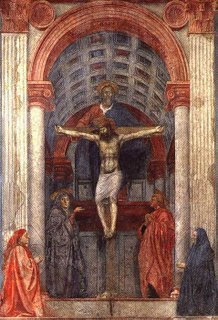
1. Trinity of Masaccio

The laws of perspective directs this composition. Only the cross and the body of Christ do not. What is the meaning of this anomaly? Is not that the being who is suspended from this cross is not of this world? It is not subject to the same laws?

2. The Italian annunciations

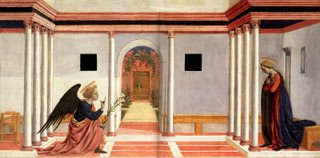
Daniel ARRASS note that many Italian annunciations presents similar anomalies. That of Domenico Veneziano, below, presents the curious feature of the show, its vanishing point, a doorknob disproportionate.

Domenico Veneziano


In this Annunciation by Fra Angelico, the vanishing point is ... forward: the middle column, preventing the eye to enjoy the depth normally generated by the flight lines

.................................... Fra Angelico


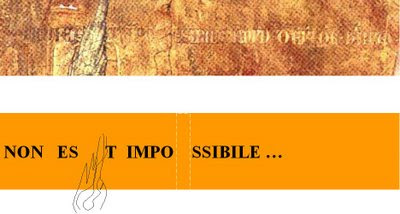
In this other Annunciation Lorenzetti, the perpespective does it seem that in the lower part tiled panel. Entire upper, gold, seems to ignore even the fact that an object can hide, even if only partially, another. Thus, before the written text: "non est impossibile " should spend a wing of the angel and the column. But the text stops at each "barrier" to restart later (see below). Without doubt this is one is, again, in a world that does not obey the laws of our own.

Ambrigio Lorenzetti
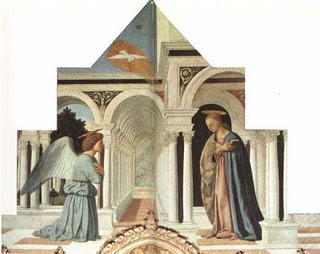
In the next Annunciation by Piero della Francesca, the angel and Mary are separated by a column. They can not see each other. The laws of perspective have allowed this paradoxical construction unequivocal. What does this mean?

.................... Piero della Francesca


Probably the latter. What is it represented in the Annunciation ? The very fact of the Incarnation . For, just when Mary agrees ("it is done according to his will"), it is permeated by the Spirit and the Savior is pregnant. But it was given to men to see Christ, God incarnate, he is given to anyone to see (or represent) the Incarnation. Anyway to give access to this event: the entry of the unrepresentable (God) in the world of things representable (the body), it was obvious to the impotence of perspectivecapable only to restore the things of our world.


The prospect is neither the means to objectively represent the world, nor the means to objectively represent our representation of the world. It can even be used symbolically to "appear" that is not our world. It is a device for expressing a new relationship in the world, a relationship in which man becomes the subject and hence the measure.

IV. SPACE AND TIME

Gradually, as the space has been unified, the time will get his unit. Successive scenes will not be displayed simultaneously on the same surface. In
Masaccio The Tribute the Carmine, there are still three times in a single space (Jesus to Peter intimating order to get money on the shore; Pierre running order; Pierre handing money). In The Banquet of Herod Philippo Lippo, Salome dance, center, receives the head of John the Baptist, left; she lays her head on the table, right.
is Leonardo da Vinci, who emphasize the incongruity there is to multiply the time dimension in the spatial unit, even Leonardo da Vinci, The Last Supper from repudiate the prospect

V. MISUNDERSTOOD THE "WINDOW" OF ALBERTI.

" My first act, when I want to paint an area, is to draw a rectangle the size that fits, as a window through which I can see the subject (historia) " De Pictura Alberti 1435 Book I, § 19 Contrary to what one might have thought, it was never intended for Alberti to open a window on the world.
It simply build the space of a table. This window is a frame. And a world table.

VI. FLORENTINE ARCHITECTURE

The picture is a world and a model for the world. Since this space Table derives the actual architectural space.
The medieval palace was a landing tower (eg Palazzo Vecchio in Florence). The Palace will be reborn antiquity. Thus marked by regularity, symmetry, proportion.
But above all by the visualization. Vision tools developed by Brunelleschi to visualize the project before its completion or even built. The architecture, with the prospect, was first designed and then implemented. It is the appearance of architectural projects.


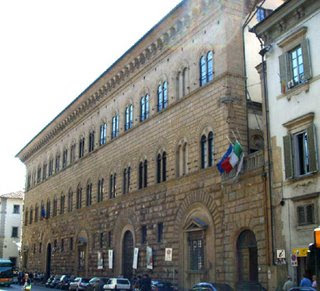
Palazzo Medici-Riccardi (Michelozzo)
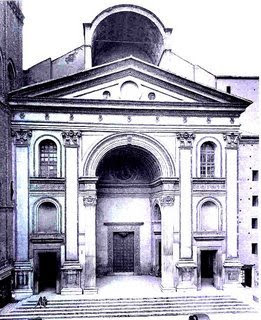
FlorenceEglise Saint-Andre (Alberti) Mantua